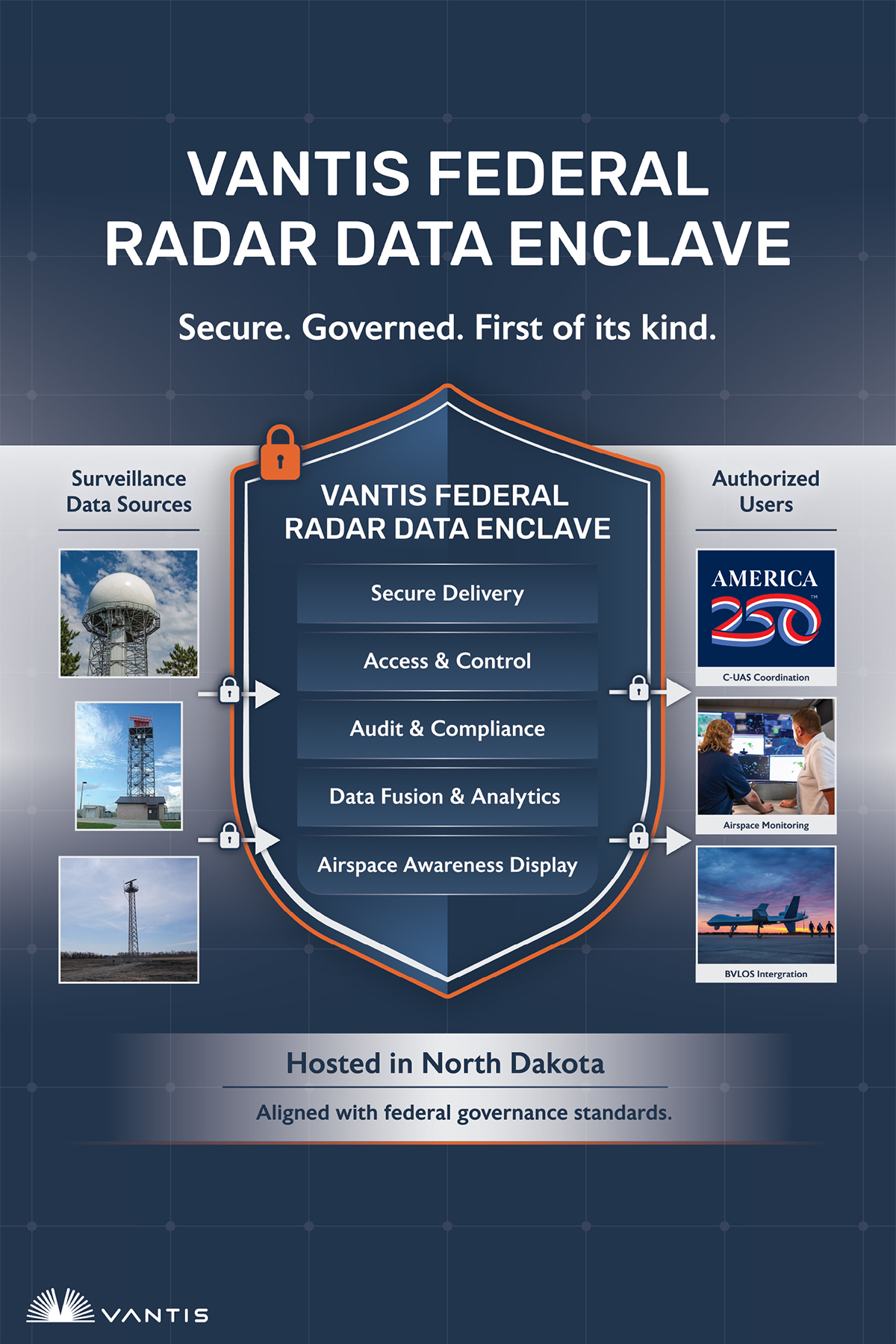
Major milestones often look simple from the outside. A press conference. A switch flipped. A capability declared operational. But activating the Vantis Federal Radar Data Enclave at the Northern Plains UAS Test Site was not a single moment. It is the culmination of coordinated effort across federal legislation, state investment, secure architecture design, cybersecurity validation, and sustained interagency trust. Operational infrastructure does not appear overnight. It is built.
Here is what is required:
1. Federal Authority
Access to unfiltered radar data requires a statutory foundation. Section 905 of the 2024 FAA Reauthorization Act directs the Federal Aviation Administration to evaluate how its radar data feeds could support the safe integration of unmanned aircraft systems (UAS) into the National Airspace System (NAS). That directive created the policy pathway for structured, secure implementation. Without legislative authority, durable access would not be possible.
2. State Investment
Federal authorization alone does not create infrastructure. Secure ingestion hardware, segmented network architecture, cybersecurity controls, and validation processes require funding and long-term commitment. The North Dakota Legislative Assembly appropriated $11 million to build the secure backbone necessary to steward federal radar data responsibly.
That investment enables:
- Dedicated enclave infrastructure
- Network segmentation
- Encryption and access controls
- Compliance and documentation processes
- Technical integration with Vantis
Modernization requires more than policy alignment, it requires financial commitment.
3. Secure Technical Architecture
Unfiltered federal radar data cannot be integrated into general-purpose systems.
The implementation requires a controlled enclave model designed to meet federal expectations for:
- Boundary protection
- Role-based access
- Encryption standards
- Logging and audit capability
- Continuous monitoring
Industry partnership is essential. Collaboration with Thales, North Dakota IT, and Mitre ensured that airspace management capabilities aligned with both operational and cybersecurity requirements. This is not a simple software update. It is a secure systems integration effort across federal and state environments.
4. Cybersecurity Validation and Review
Access to federal radar data requires extensive review and validation.
Security controls were examined to ensure:
- Data would remain within defined governance parameters
- Access was restricted to authorized users
- Use cases were clearly defined
- Operational integration would not introduce risk to the broader NAS
Validation processes were deliberate and rigorous – a necessary step to preserve trust.
5. Interagency Coordination
Implementation requires alignment among:
- Federal stakeholders
- State leadership
- Technical integrators
- Security reviewers
Access to sensitive surveillance data is not simply a technical handshake. It is an interagency coordination effort built on documentation, process, and accountability. Trust was not assumed. It was earned.
What “Operational” Really Means
In aviation, the word operational carries weight. It means systems have been built, tested, secured, validated, and approved within defined governance structures.It means roles are clear, controls are documented. Oversight mechanisms exist. The activation of the Vantis Federal Radar Data Enclave represents more than technical integration. It is a foundational step toward secure digital airspace infrastructure.
Modernizing the NAS requires:
- Legislative alignment
- Financial investment
- Secure architecture
- Cyber discipline
- Interagency trust
Each layer is essential, each layer takes time.
A Model for Responsible Integration
As the FAA prepares to outline additional participation pathways under Section 905, interest in radar data access will continue to grow. The lesson from this activation is clear: Access to federal radar data is achievable, but it must be structured. It must be secure and it must be governed. Operational capability is built, not requested.